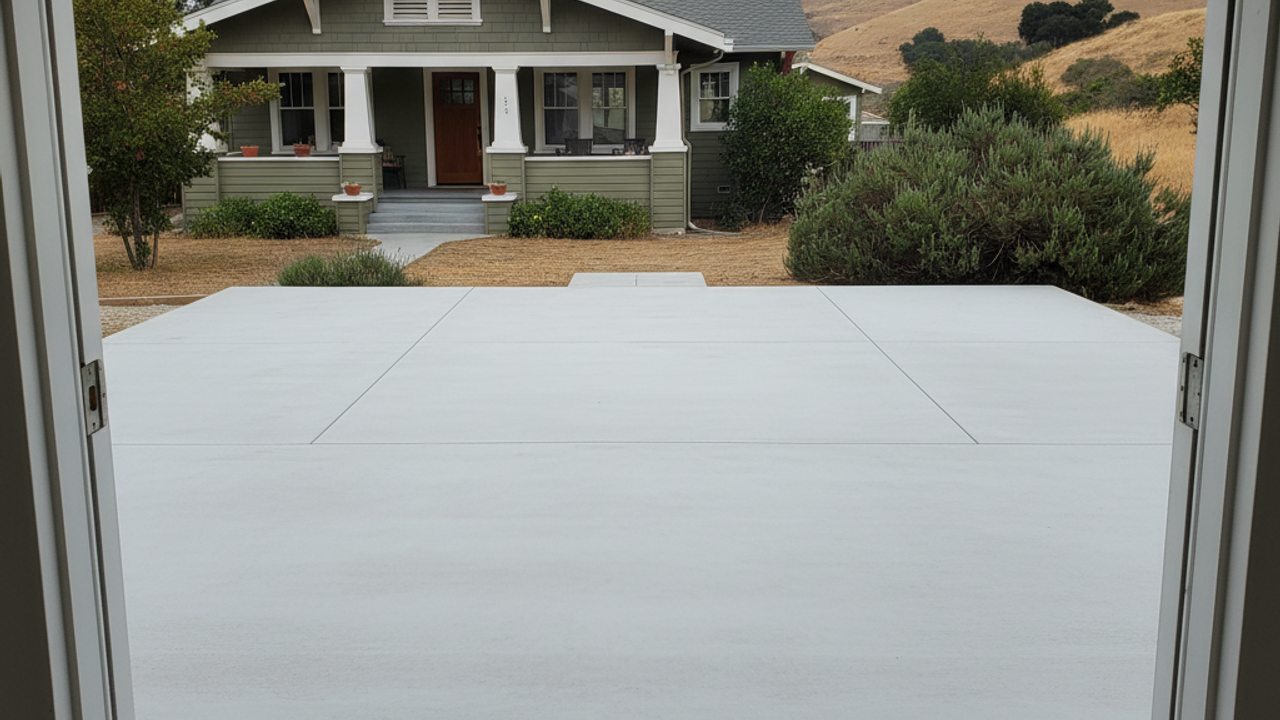
Concrete looks simple once it's down. A gray slab, maybe stamped or colored, sitting flat where there used to be dirt. What you don't see is the base rock underneath it, the rebar or wire mesh tied into it, the soil it's sitting on, and the grading that decides whether water runs away from your house or pools against it. Before anyone pours anything in the Los Angeles area, there are a handful of things worth checking yourself, or at least asking your contractor about directly.
What's actually in the ground before anyone breaks it
Los Angeles doesn't sit on one kind of soil. Parts of the San Fernando Valley and South LA have expansive clay that swells when it's wet and shrinks and cracks when it dries out, which is exactly the kind of movement that cracks a slab if the base under it isn't prepped right. Closer to old riverbeds and wash areas, you get sandy alluvial soil that drains fast but can settle under weight if it wasn't compacted before the pour. Up in the hills, Mount Washington, Eagle Rock, parts of Silver Lake, you can hit bedrock or shale a couple feet down, which changes how deep a footing or retaining wall needs to go.
- Ask what the subgrade compaction is. A common target for slab subgrade is 90% relative compaction. If nobody's testing for it, nobody actually knows.
- Call 811 before any digging. Underground Service Alert will mark gas, electric, and water lines. Older streets, especially anything built in the 1920s through 1940s like West Adams or Highland Park, often still have clay sewer laterals that are brittle and already full of tree roots. Hitting one mid-job is a bad day for everyone.
Where the water has to go once the slab is down
A patio or driveway that doesn't slope right doesn't fail the day it's poured. It fails the first heavy rain. Concrete flatwork near a house should pitch away from the foundation, roughly a quarter inch per foot, so water doesn't sit against the slab or find its way under it. A lot of older LA lots were graded decades ago and have settled flat or even slightly backward since.
LA's rain doesn't come often, but when it does, between November and March, it can come hard and fast, and a lot of residential streets have storm drains that weren't sized for it. If your lot already holds water in a downpour, that's something to fix in the grading before the concrete goes down, not after.
The permit before the permit
Inside the city of Los Angeles, LADBS handles the permit and inspection. Step outside the city line and you're dealing with a different department entirely, Pasadena, Glendale, Santa Monica, Burbank, and Long Beach all run their own building and safety offices with their own inspection schedules. If your job touches the sidewalk, curb, or driveway apron where it meets the street, that part is often inspected separately by the Bureau of Engineering, not the building department.
If you're anywhere near a property line, a setback check or a current survey matters more than people expect. And if your street falls inside a Historic Preservation Overlay Zone, which covers parts of West Adams, Angelino Heights, and a few other older neighborhoods, there can be restrictions on driveway material and even the pattern of a sidewalk replacement. Worth knowing before you pick a finish, not after.
What's actually inside the slab
Thickness and reinforcement should match what the slab is for, not just be whatever's standard. A sidewalk or walkway can get by at 4 inches with wire mesh. A driveway that's going to carry a car every day, especially over clay soil that shifts, holds up better at 5 to 6 inches with rebar instead of mesh, since rebar stays put in the middle of the pour where it actually does something.
- Control joints should be cut roughly every 8 to 10 feet, and cut within 24 to 48 hours of the pour. Concrete is going to crack somewhere as it cures. The joint just decides where.
- On expansive clay, a thicker base layer, 4 to 6 inches of compacted class II road base, gives the slab something more stable to sit on than clay alone.
Timing, heat, and how long before you can use it
Summer heat in the Valley, routinely over 95 degrees from June through September, dries the surface of fresh concrete faster than the inside can cure, which is how you get plastic shrinkage cracks, fine surface cracks that show up within hours. A contractor working in that heat should be covering the slab or applying a curing compound, not just letting it sit in the sun.
As a rough timeline: most slabs can be walked on in 24 to 48 hours, driven on after about 7 days, and reach full design strength around 28 days. Stamped and colored concrete needs the full cure window respected even more closely, since sealing it too early traps moisture under the sealer and causes it to cloud or peel.
None of this is complicated, but it's the kind of thing that only shows up as a problem months or years after the truck leaves. Checking the soil, the grading, the permit situation, and the mix and reinforcement before the pour is cheaper than fixing a cracked or sunken slab later. That's the kind of up-front checking Precision Concrete Co does on every job before a shovel goes in the ground.